


Harvest time: 13.4.2026.
Origin: Liu An, Anhui, China
Garden height: 550 m
Cultivar: Qishanzhong
Picking Method: Manual
Liu An Gua Pian is one of the ten famous Chinese teas, and this tea may also be the most expensive considering that its manual processing takes about half a month to complete, which involves a lot of artistic and painstaking work. In the Qing Dynasty, this was a precious tea for royalty. Although, due to its rarity, the offer is limited to a few members.
The historically famous Empress Cixi, then the highest-ranking imperial concubine, was not qualified to consume this tea until she gave birth to an heir to the throne. At that time, she was getting a supply of about two pounds of Liu An Gua Pian every month.
This tea is special in its appearance and is somewhat reminiscent of watermelon seeds, which is how it got its name. In processing, the buds and peduncle are removed, leaving a clean leaf. The last roast is a particularly difficult job and a crucial step for the quality of this tea. The finished product of Liu An Gua Pian is green in color from jade and covered with a thin layer of white hairs. It has a strong smell when cooked, and its taste is very slightly sweet.
Liu An Gua Pian is produced in Qishan Mountain in the southwest of Anhui, and the tea garden in front of the bat cave is considered the original tea garden in the Qishan region.
Cave 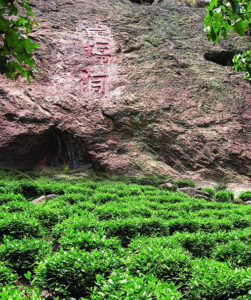
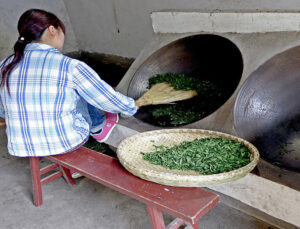
With a special method of picking, only the leaves are torn, without buds and petioles, which are placed on the bamboo to dry slightly. The leaves need to be dried three times on a bamboo base, which is a unique and key processing in forming the quality of Liu An Gua Piano.
After light drying, the tea leaves are sent for frying. Liu An Gua Pian is special in that it needs to be fried twice.
The first time at a temperature of about 100 °C, and the second time at 80 °C. During the second roasting, the tea is also rolled at the same time.
After two roasts, the water content in the leaves is about 30% and goes for further roasting. It is baked in a basket at 100°C. Then it is stirred and returned to the fire again. This procedure is repeated several times until the water content of the tea leaves is about 15%. Another important criterion is that no heat smoke should appear during the roasting process so that the tea does not absorb it and spoil.
The second roasting is carried out at 120 °C for about ten seconds. When cooled, it is heated again. This procedure is repeated 40-50 times until the water content of the tea leaves is about 10%. It is then set aside for 3-5 days to regain some natural moisture, waiting for the last roast.
Last roastIt is a particularly difficult job and a crucial step for the quality of this tea.
This is the most critical and difficult arrangement of Liu An Gua Piano. With this baking, the temperature on the surface of the basket rises to 160-180°C. The tea basket can be put on fire for only 1-2 seconds, then it must be immediately set aside for stirring and cooling. This procedure will be repeated about 100 times. Several baskets are stacked in a row for processing and the team of workers must be very well coordinated to manage them at the same time. It requires quite agile and careful handling to avoid burning the teas.
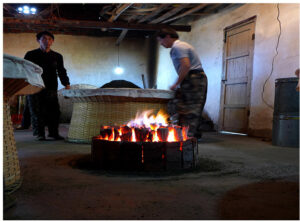
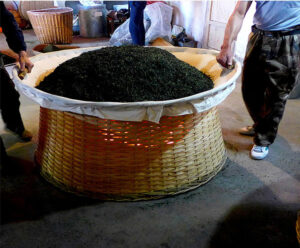
In the last stage of processing, the tea takes on a white layer on the surface, which is an important part and a reference of the quality of Liu An Gua Pian tea. Finishing will reduce the water content of the tea leaves to 4-5%. The finished tea is packed in iron barrels and sealed immediately after roasting while the tea is still hot.
The finished product of Liu An Gua Pian is green in color and covered with a thin layer of white hairs. It has a strong smell when cooked, but its taste is very mild.
Preparation – kettle:
• 2 g tea
• 200 ml of water
• temp. 75° – 80°C
• 3 pour-overs: 2 min, 2.5 min, 3 min
Preparation – gaiwan:
• 4 g tea
• 120 ml water
• temp. 80°C
• Overflow 5: 20s, 30s, 40s, 50s, 70s

