Harvest time: May 19, 2024
Origin: Fujian, China
Garden height: 1000 m
Cultivar: Tie Guan Yin
Picking Method: Manual
The Tea Garden is located at the top of Da Gu Shan Mountain in southern Fujian. The altitude of the garden is 1000 m and it is located very high among the tea mountains of southern Fujian. Since 2020, tea has been grown completely naturally in this garden without the use of pesticides.
Cool and sunny weather is ideal for producing high-quality Tie Guan Yin oolong tea. Farmers of southern Fujian call such Tie Guan Yin carried by the north wind “happy oolong”, because usually the tea stops growing before the north wind blows. Such tea can only be grown in very high mountain tea gardens, and this mountain tea garden is also surrounded by rich dense forests.
Harvest time is crucial for the good quality of Tie Guan Yin. An experienced tea grower decides when the tea is ready to be harvested. Tea leaves should not be too old or too young, because regardless of the best processing techniques, if the raw material is not good, the tea will ultimately not be of good quality.
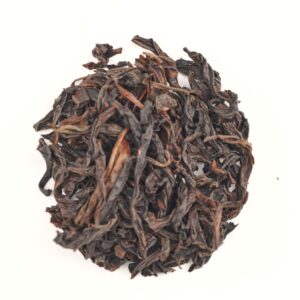
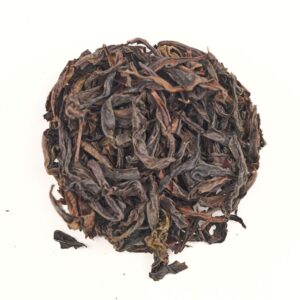
This Tie Guan Yin has a very pleasant orchid-like aroma, and thanks to the high-altitude environment and natural cultivation, the flavor is rich and deep.
The harvested leaves are spread out for drying in the open air. Drying is carried out in the evening and takes about an hour. After it dries, it is sent for fermentation. The tea is turned in a round bamboo barrel for about ten minutes and then shaken additionally on a bamboo base. During these treatments, the tea leaves are damaged, especially on the surface and marginal part in order to ferment. Fermentation occurs when the juices from the tea leaves in damaged cells on the surface and edge of the leaves react with oxygen. On the other hand, the tea juice in the inner part of the leaf remains unfermented because in the inner part the tea cells remain intact and protected from oxidation by the cell membrane. That is why oolong tea is semi-fermented, i.e. partly fermented and partly unfermented.
Once the tea is fermented, it is placed to be roasted in the oven to kill enzymes and stop fermentation. Baking is usually carried out the next morning. During tea roasting, the entire study room is filled with a charming orchid-like scent.
After the tea leaves are roasted, they are packaged in a cloth bag and then bound on a simple machine that will rotate the cloth bag and throw it onto a hard stone slab thus removing the deeply fermented parts of the leaves that are crispier and harder and later sorted.
The next step is to wrap the sheets in bags of approximately 10 kg and place them on a rolling stand. Rolling is usually repeated three times to get a firm body of Tie Guan Yin. The tea is then sent for final drying, and finally the petioles are manually separated from the final product.
Preparation – kettle
- 4 g tea
- 200 ml of water
- Temp. 95°C
- 4 pour-overs: 1 min, 1.5 min, 2 min, 3 min
Preparation – gaiwan
- 6 g tea
- 110 ml of water
- Temp. 95°C
- Overflow 6: 30s, 40s, 50s, 70s, 100s, 120s