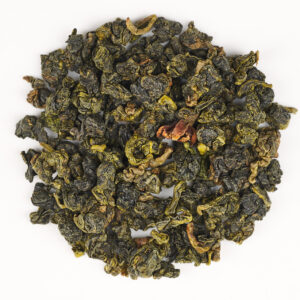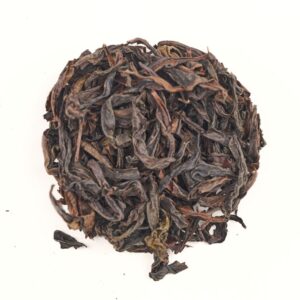


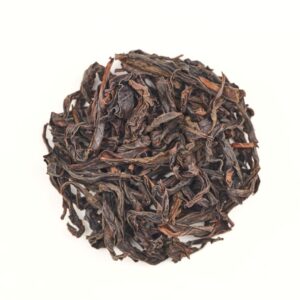
Harvest time: spring 2023
Origin: Wuyishan, Fujian, China
Garden height: 700 m
Cultivar: Rou Guy
Picking Method: Manual
This tea won a silver medal for Rougui in 2023. Interestingly, only real farmers from the Tianxin village of Wuyishan can enter the competition.
Peng Bao, the producer of this tea that we had the opportunity to meet in person recently during our visit to China, comes from generations of tea tree growers in Wuyishan Park. He is a master in the art of Yáo qīng, i.e. The process of combining several types of teas to obtain the best taste, which is the most important stage for the production of high-quality Wulong teas. He took us through his gardens and instructed us in the process of blending teas when we needed to make our own blend for Da Hong Pao according to his example.
His skill earned him numerous gold and silver medals in competitions.
No other tea from this rocky region can match the warm complexity of Rougui. Its typical and rich minerality is enriched by an intense roasting flavor that is retained in the aftertaste. This tea, grown in the heart of Wuyishan Park, is very intense and releases a specific roasting aroma that fills the palate with every sip.
The name Rougui literally means cinnamon, and there is also a hint of sandalwood in the aroma. This tea has undergone triple roasting, which gives it a unique warm complexity. It is a long and delicate process that ends only in November. The tea plant itself carries some piquancy, which can be good or bad, depending on the skill of the tea master. An experienced tea master will be able to remove this spiciness, but not the richness of the tea. Good Rougui has fruity aromas along with a light pleasant aroma of bay leaf, and is a great tea for cold winter evenings.
Peng Bao inherited the Dahongpao, Rougui, Shuixian, Jinmudan, Huangjingui, and Bairuixiang varieties that grow right below the top of Yingzui, named for its resemblance to an eagle’s beak and absorb the unique mineral aroma that has made rock teas prized and popular.


Zhengyan refers to the so-called “Full Rock” area located in the territory covered by the “Three Pits and Two Streams”.
The three pits are:
– HuiYuan Pit
– NiuLan Pit
– DaKeng Pit
The two streams are:
– LiuXiang Stream
– WuYuan Stream
In addition to this famous area, there are 36 other peaks and 99 rocks belonging to this ZhengYan area: HuiYuan Rock, Matou Rock, TianXin Rock, Sanyang Peak, Shulian Cave, etc.
Zheng Yan translates as “source ofnot a stone”. In 1999, the Chinese government declared the Zhengyan area in the Wuyi Mountains a Wuyi World Heritage Reserve. Indeed, this area has many original varieties of tea that farmers should strive to preserve.
Zhengyan teas tend to be more expensive since all the teas there are organic — the government bans pesticides in the Zhengyan Reserve area. Furthermore, the climate here is optimal for tea cultivation because there is a lot of precipitation and fog throughout the year.
If you want to try premium yancha (rock tea) but don’t know where to start, we recommend trying teas from the Zhengyan area. They are commonly sold under the name Zhengyan tea, Zhengshan tea (original mountain tea), or tea from a nature reserve.
The final process of roasting these teas is done using charcoal, enriching the tea with a long-lasting roasted aroma. The first roasting is done between May and June, the second is done in August, while the third roasting takes place between October and November.
These teas are worth the wait because they bring new warmth to the cold season.
Preparation – Yixing clay teapot:
• 5 g tea
• 110 ml of water
• temp. 100°C
• Overflow 5: 10s, 10s, 20s, 30s, 50s
Preparation – gaiwan:
• 5-6 g of tea
• 120 ml water
• temp. 100°C
• Overflow 5: 5s, 10s, 15s, 25s, 40s