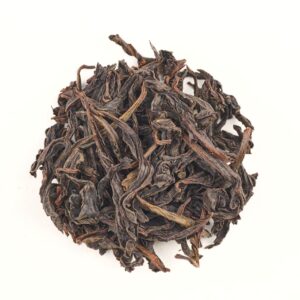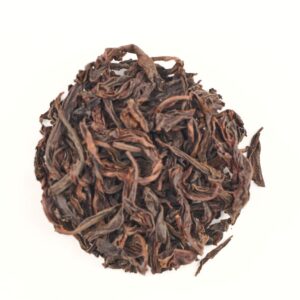
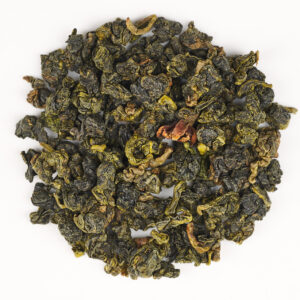


Harvest time: spring 2023
Origin: Wuyishan Zhengyan, Fujian Province, China
Garden height: 700 m
Cultivar: Qidan
Picking Method: Manual
Produced from the Qidan variety obtained by cuttings from one of the six mother trees of Dahongpao, which gives it an intense taste and an exceptional floral aroma accompanied by a note of roasting that is retained in the aftertaste.
Spicy notes of cinnamon, sweet caramel and sandalwood are felt and provide a unique sensory experience.
The tea garden is located under the Yingzui Peak named for its resemblance to an eagle’s beak and absorbs a unique mineral aroma.
In the second picture you can see the protected six Da Hong Pao mother trees located in Wuyishan National Park (top right).
Zhengyan refers to the so-called “Full Rock” area located in the territory covered by the “Three Pits and Two Streams”.
The three pits are:
– HuiYuan Pit
– NiuLan Pit
– DaKeng Pit
The two streams are:
– LiuXiang Stream
– WuYuan Stream
In addition to this famous area, there are 36 other peaks and 99 rocks belonging to this ZhengYan area: HuiYuan Rock, Matou Rock, TianXin Rock, Sanyang Peak, Shulian Cave, etc.
Zheng Yan translates as “original stone”. In 1999, the Chinese government declared the Zhengyan area in the Wuyi Mountains a Wuyi World Heritage Reserve. Indeed, this area has many original varieties of tea that farmers should strive to preserve.
Zhengyan teas tend to be more expensive since all the teas there are organic — the government bans pesticides in the Zhengyan Reserve area. Furthermore, the climate here is optimal for tea cultivation because there is a lot of precipitation and fog throughout the year.
If you want to try premium yancha (rock tea) but don’t know where to start, we recommend trying teas from the Zhengyan area. They are commonly sold under the name Zhengyan tea, Zhengshan tea (original mountain tea), or tea from a nature reserve.
The final process of roasting these teas is done using charcoal, enriching the tea with a long-lasting roasted aroma. The first roasting is done between May and June, the second is done in August, while the third roasting takes place between October and November.
Peng Bao, the producer of this tea that we had the opportunity to meet in person recently during our visit to China, comes from generations of tea tree growers in Wuyishan Park. He is a master in the art of Yáo qīng, i.e. The process of combining several types of teas to obtain the best taste, which is the most important stage for the production of high-quality Wulong teas. Conducted byhe also instructed us in the process of blending teas with his gardens when we needed to make our own blend for Da Hong Pao according to his example.
His skill earned him numerous gold and silver medals in competitions.
These teas are worth the wait because they bring new warmth to the cold season.
Preparation – Yixing clay teapot
- 5 g tea
- 110 ml of water
- temp. 100°C
- Overflow 5: 10s, 10s, 20s, 30s, 50s
Preparation – gaiwan
- 5-6 g of tea
- 120 ml water
- temp. 100°C
- Overflow 5: 5s, 10s, 15s, 25s, 40s