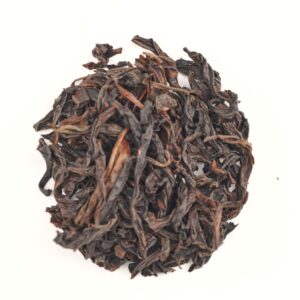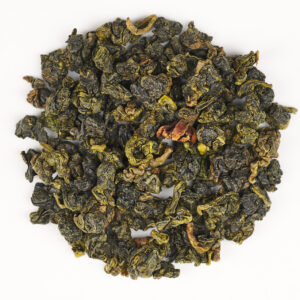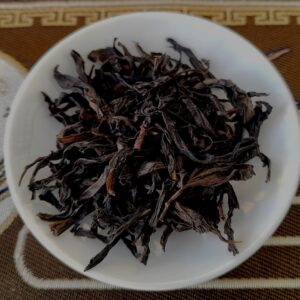
Harvest time: spring 2023
Origin: Wuyishan, Banyan, Fujian, China
Garden height: 640 m
Cultivar: Shuixian
Picking Method: Manual
Shuixian is the most delicate “rock tea”, i.e. tea that grows on the rocky area of Mount Wuji. The subtle mineral notes it gets from Banyana soil and the low degree of roasting result in a tea with a rich floral aroma. The main note that can be felt is the warm note of daffodil, which is actually the true meaning of the Chinese term Shuixian.
The Shuixian variety is one of the most suitable for the aging process. It was originally grown in Guangdong and later brought to Fujian to Wuyishan Park, where it acquired its unique minerality and great complexity.
Yancha, or “rock tea”, are wulong teas that grow in the heart of Wuyishan Park in Fujian Province.


This is a very humid area, the main feature of which lies in its steep rocky hills. This type of soil was also praised by Lu Yu during the Tang Dynasty (618-907) as the most suitable for tea cultivation.
Banyan is a tea that grows on the edges and outside the national park in a semi-rocky area.
It is often grown in the same way as Zhengyan yancha (tea that grows on rocky territory in a national park, protected by UNESCO and strictly controlled cultivation without pesticides). This tea still has a lot of Zhengyan characteristics because it grows on almost the same soil, although the unique environment in which Zhengyan yancha grows is hard to beat. Pesticides are allowed to be used here outside the national park, but they are not always used.
The final process of roasting these teas is done using charcoal, enriching the tea with a long-lasting roasted aroma. The first roasting is done between May and June, the second is done in August, while the third roasting takes place between October and November.
Peng Bao, the producer of this tea that we had the opportunity to meet in person recently during our visit to China, comes from generations of tea tree growers in Wuyishan Park. He is a master in the art of Yáo qīng, i.e. The process of combining several types of teas to obtain the best taste, which is the most important stage for the production of high-quality Wulong teas. He took us through his gardens and instructed us in the process of blending teas when we needed to make our own blend for Da Hong Pao according to his example.
His skill earned him numerous gold and silver medals in competitions.
These teas are worth the wait because they bring new warmth to the cold season.

Preparation – Yixing clay teapot:
• 5 g tea
• 110 ml of water
• temp. 100°C
• Overflow 5: 10s, 10s, 20s, 30s, 50s
Preparation – gaiwan:
• 5-6 g of tea
• 120 ml water
• temp. 100°C
• Overflow 5: 5s, 10s, 15s, 25s, 40s